Open Teacher desk, choose a week and Start guided week. The teaching companion gives preparation, practical small-group drama steps, model invitations, observation cues and access choices. Choose the current teaching step as you lead the lesson.
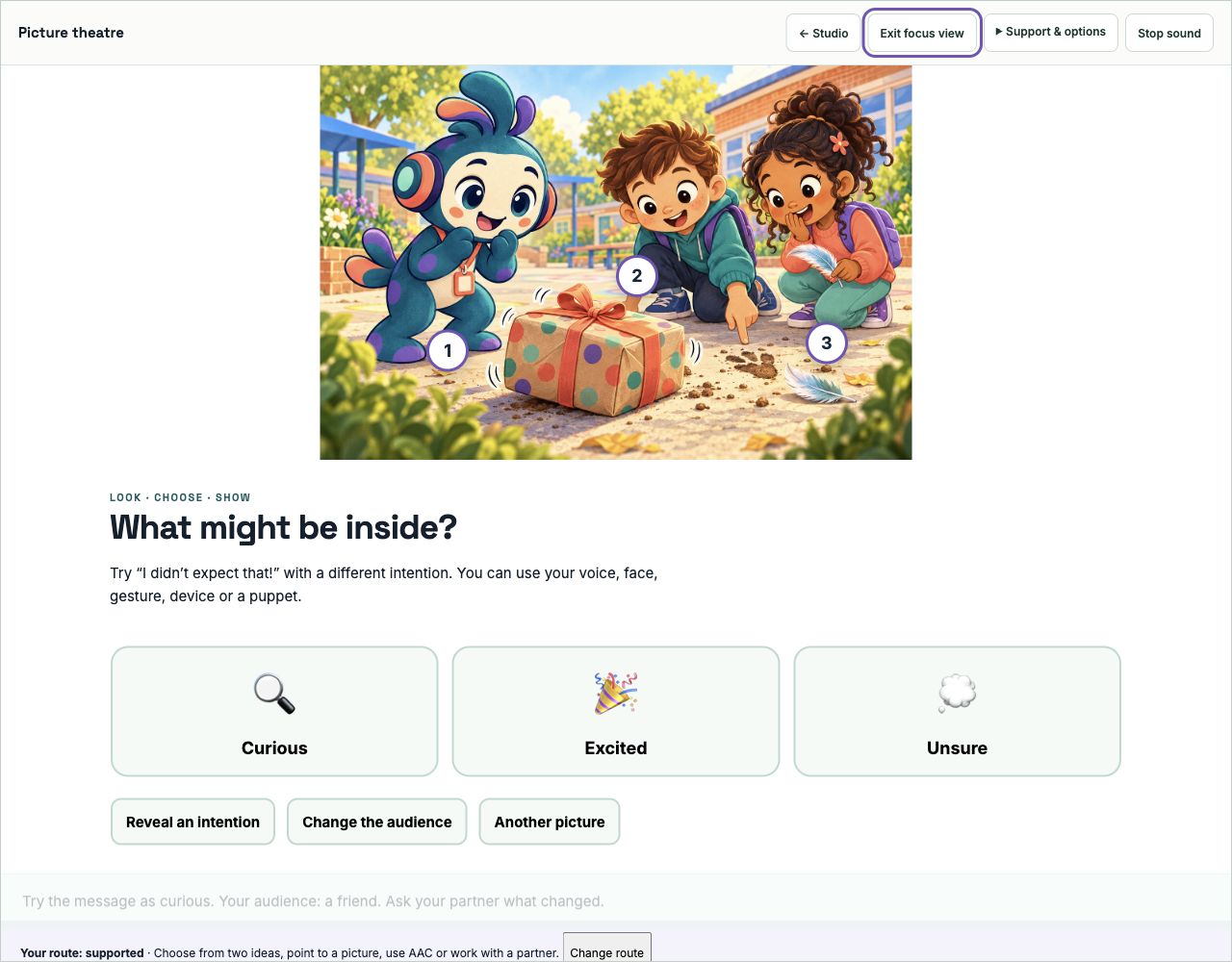
Use Pupil view for projection; Exit focus view returns the teacher guidance. The complete lesson sequence remains below and in the printable manual.
Drama first. More ways to join.
Plan a starting group of around 4–6 pupils with a trained lead and support matched to communication, access and regulation needs. Group size is a practical planning choice, not a fixed staffing ratio. For a class of 30, repeat the full lesson across separate group slots, or use shorter supervised practice stations. An eight-minute station is not equivalent to a 55-minute lesson. Each core lesson totals 55 minutes; split into shorter turns while preserving check-in and reflection. Continue, Consolidate or Extend from evidence, not a calendar deadline.
The Studio agreement
Speech, AAC, symbols, signing, gesture, writing, recorded voice, character, communication partner and listening first are valid routes. No pupil is required to make eye contact, speak live or share publicly. Watching, passing and returning later are participation choices. Respond to meaning rather than accent, fluency, speed or performance style.
Professional roles
A trained lead models drama, ensemble safety, physicality, character distance and improvisation. An access lead prepares AAC, local device speech and optional recording. School staff practise, adapt and review delivery. Each modelled session leaves a repeatable exercise, an observation and one adult facilitation target.
Privacy and permission
Use anonymous adult examples for demonstrations. Do not type identifiable pupil data into this demo or unapproved services. Confirm school permissions before recording; agree approved storage, access and deletion. Notes stay in this tab using sessionStorage and may be restored by the browser. Export only if useful, then Clear session on shared devices. Downloads are not deleted by Clear session. Recordings stay in memory and must be downloaded before leaving Character Bridge if you want to keep them.
This is an educational programme, not therapy or a diagnostic assessment. This plan adapts the supplied eight-week scheme to the actual demonstration system. Use the activities alongside the teaching guidance and adapt access to the group.
WEEK 1 · 55 MINUTES
Welcome to The Studio
Safety, choice and a starting point
Outcome: Choose a way to join, communicate in two familiar tasks, and agree one small goal.
Observe: Confidence and participation; communication choices; expressing ideas
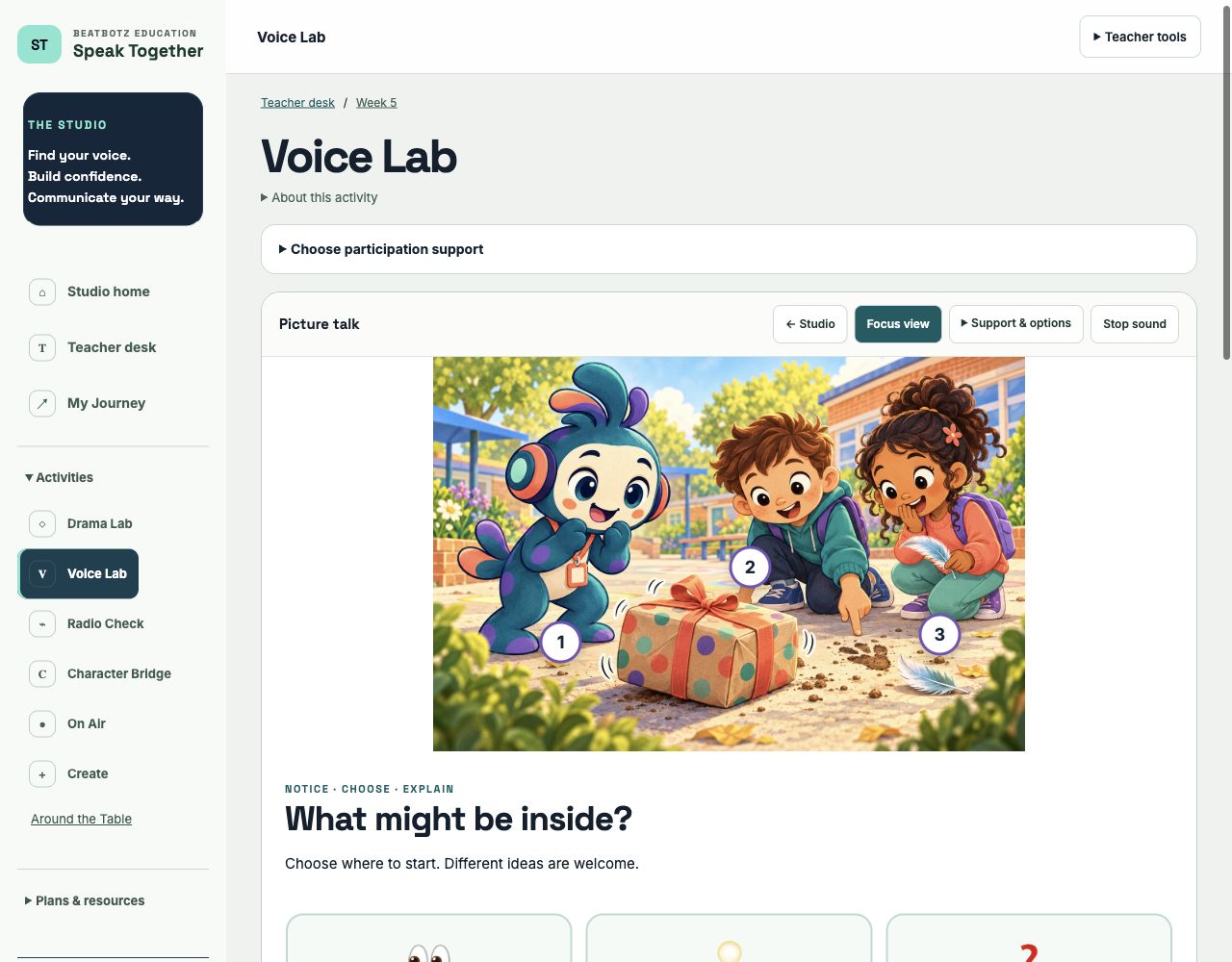
Familiar picture prompts, objects, usual AAC system and vocabulary, a quiet observe space and two activity stations. Open Voice Lab and the communication board. Use anonymous notes; check school recording permissions before offering audio.
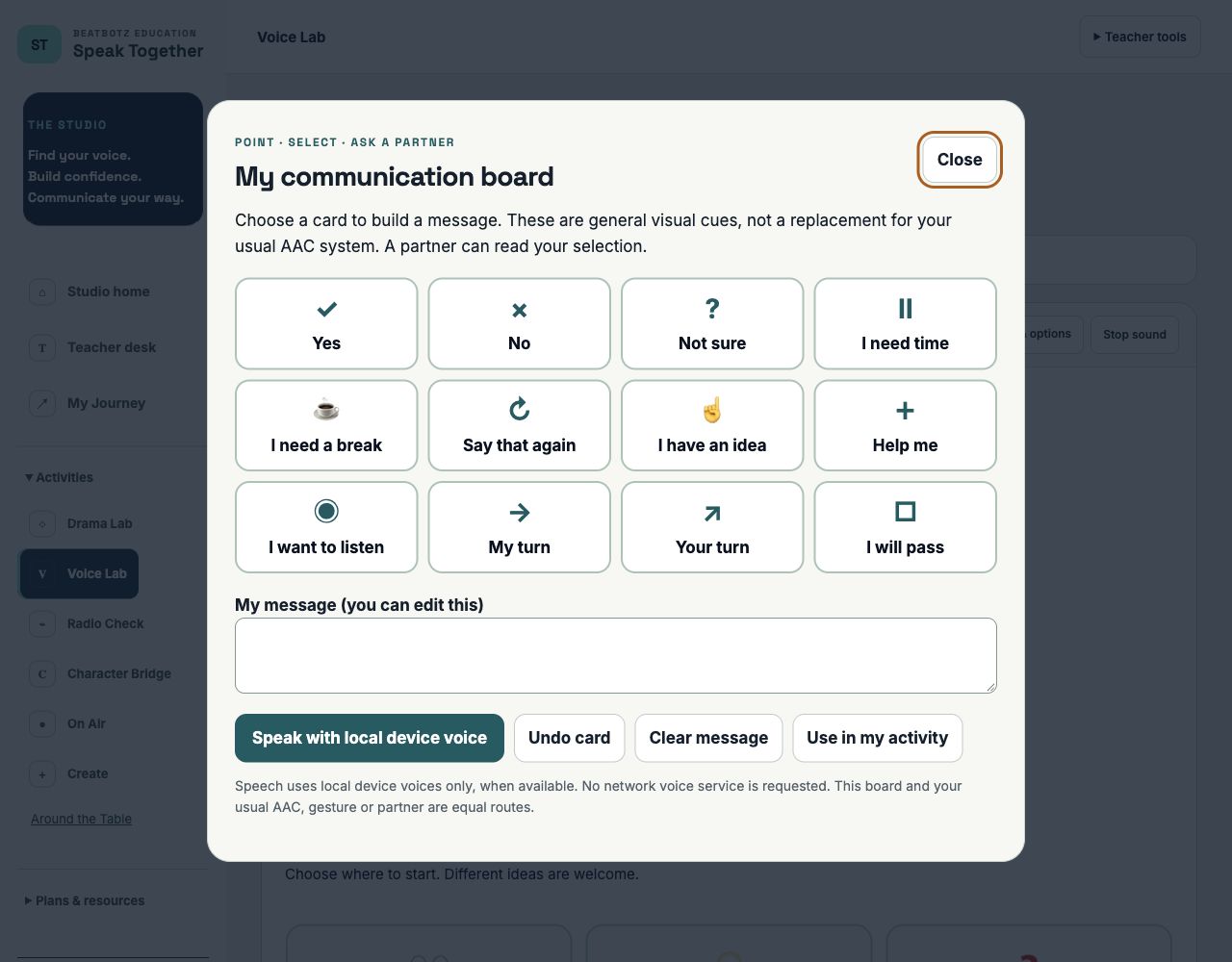
Communication board: offer a choice and give time. A partner can read the pupil-selected message; usual AAC remains available.
Deliver the lesson 55 minutes · adapt the pace
5 MIN
Radio Check: arrive and choose
Show a feeling or energy cue and ask how each pupil wants to join. Accept a point, sign, gesture, device selection, speech or watching. Agree pause, pass and return signals; model the communication board without requiring its use.
In the system / room: Voice Lab: communication choices; board: I need time / I want to listen.
8 MIN
Name + Action
Adult offers a fictional name or neutral greeting with one movement, symbol or sound. Invite the ensemble to mirror once. Pupils can offer, choose for an adult to perform, or watch. Avoid requiring names or personal disclosure.
In the system / room: Room-based drama; a puppet, object or seated gesture can carry the action.
10 MIN
Explore communication choices
Model the same idea by gesture, text and a device. Pupils choose helpful methods and supports; ask what is useful today, rather than making a permanent label. Make an optional plan in the facilitator tools.
In the system / room: Open planning tools: choose methods and supports. Symbols, partner and listen-first routes remain available.
22 MIN
Choose two stations
Offer share a favourite fictional object, select a question, describe a picture, or respond to a surprising classroom prop. Model one turn. Pupils choose two tasks, each with a clear listener. Wait, invite a check and change support if needed.
In the system / room: Use Picture talk for a shared prompt, or physical objects. Start / Build / Finish can hold a short message; a partner can scribe.
5 MIN
Notice the experience
Ask Easy / I could have a go / I needed help / Not yet. Accept nonverbal selection and exact pupil words where offered. Notice route and support, not whether speech occurred.
In the system / room: My Journey: starting-task rating, strength and barrier; these are not scores.
5 MIN
Choose one next step
Complete ‘This week I would like to try…’. Identify a familiar context and support role. End with the same calm gesture or sign-off. Offer a private reflection and the right not to share.
In the system / room: My Journey: starting task, route, next goal and context. Download an anonymous snapshot only if useful.
Supported route
Observe first; offer two choices; adult models or voices the pupil-selected message. Use 1:1 partner, symbol, gesture or familiar AAC.
Independent route
Choose two stations and communicate with the displayed prompt sequence. Request support when wanted.
Challenge route
Add a less familiar listener, one reason or one agreed follow-up question while retaining access supports.
Drama facilitation
Model invitation, safe mirroring and noticing reluctance without lowering expectations. Staff practise waiting rather than filling silence.
Teacher language
You can join in your way. Watching first is joining. Would you like to say it, show it, choose it or use a character?
Evidence worth keeping
Record the starting task wording, chosen route, support, one strength, one barrier and the pupil's task rating. Enter separate baseline strand descriptors only where observed. Do not invent a complete baseline.
Continue
Repeat the station structure with new familiar prompts.
Consolidate
Keep partner and task familiar; reduce choices and preserve the quiet return route.
Extend
Invite an unfamiliar listener or one spontaneous follow-up, with pupil agreement.
Between sessions
Offer a communication choice at the start of a normal classroom discussion.
Reflect and embed
Notice one invitation that preserved agency. Rehearse the same invitation with a colleague and decide who prepares the next AAC vocabulary.
DRAMA, PUPPETS & GROUPS
Name + Action
Lead the game: At the warm-up, offer a fictional greeting and one movement. Pupils can mirror, select a movement for an adult, or observe. Use a seated/object route.
Use a puppet here: Use a puppet as the welcome host. It can offer a place, model a pause/pass signal or carry the pupil’s selected greeting.
Arrange the group: Guided group of 4–6; offer a turn without a compulsory circle. A partner can rehearse beside the pupil first.
RESOURCE BASKET
Puppets, props and communication
Puppets & props: Pip picture or familiar puppet; fictional objects; a simple visual agenda; a quiet observe place.
AAC options: Everyday choices and Voice Lab boards; pupil’s usual yes/no, help, pause and participation vocabulary.
Prepare: Preview the meaning of each cue; offer two familiar choices and a partner route. Agree a starting task and accessible feedback.
Pip arrives at an imaginary café. Offer a place, a greeting or time to watch.
Focus: Joining, greeting and choosing a route
Optional 10-minute practice: welcome and choose (2), rehearse (5), notice and step out (3). Eating is optional; food-free, AAC, partner and listening routes are equal.
Transfer: Choose how to join a familiar snack or lunch moment.
Clear personal-space spots and a seated/object route. Prepare ‘That's brilliant’, intention cards and audience choices. Open Drama Lab. Avoid prompts that imply feelings can be known from appearance alone.
Drama Lab: use intention and audience choices to rehearse how one line changes meaning. Acting, directing a puppet and nonverbal routes are equal.
Deliver the lesson 55 minutes · adapt the pace
5 MIN
Radio Check
Choose energy and participation route. Revisit the kind-audience agreement: no copying a pupil outside the activity, no forced eye contact, and pass-and-return is available.
In the system / room: Communication board and route choices; an adult checks usual AAC is ready.
10 MIN
Walk the Room
Model moving as an expert, unnoticed, excited or confused; then move a puppet/object or use seated hands. Invite one chosen quality. Freeze and notice what the movement suggests without claiming to know the performer's feelings.
In the system / room: Room-based drama is central; use the Drama Lab picture as a discussion prompt if useful.
8 MIN
Model expressive choices
Say or show the same neutral line twice. Change one feature: pace, pause, gesture, face, position or volume. Pupils select what changed. With AAC, vary timing, prepared wording or gesture alongside the device; do not demand a different voice.
In the system / room: Drama Lab: expression and audience prompts; device speech is optional.
20 MIN
Same Words, Different Meaning
In pairs, choose an intention and rehearse ‘That's brilliant’. The pupil may act, direct an adult, use a puppet, select a response or use prerecorded audio. Listener describes the message they received; performer can repair or try again.
In the system / room: Picture theatre: select an emotion/intention or clue. Planning tools offer further drama prompts and an optional timer.
7 MIN
Shift the audience
Repeat for a friend, younger listener or someone who is unsure. Change only what helps meaning. Invite a reason for the choice through the pupil's communication route.
In the system / room: Audience prompt in Drama Lab; pupils can pass and return.
5 MIN
Playback and notice
Name one expressive tool and one thing to try next. Give specific feedback: ‘You paused before the important word’. Avoid judging polish, volume or theatrical talent.
In the system / room: My Journey: record a concrete expression choice and the support available.
Supported route
Mirror an adult; choose one intention; direct a puppet or use a prepared recording. Work beside a trusted adult.
Independent route
Choose an intention and alter two features while keeping the message clear.
Challenge route
Try a new audience card and justify three choices, including device timing or physical choices if useful.
Drama facilitation
Lead physicality, vocal variety, modelling and ensemble safety. Demonstrate a confidence ladder with manageable, reversible steps.
Teacher language
Make it clear, not big. Show the meaning in one part of your body or voice. You can perform beside me or through an object.
Evidence worth keeping
Record one deliberate expressive change, the listener's interpretation, any repair and willingness to repeat. Record route and scaffold; do not rank acting ability.
Continue
Use the same line with new intentions.
Consolidate
Work on one expressive feature with a familiar partner.
Extend
Add audience shifts, status changes or a brief improvised exchange.
Between sessions
Try two ways to deliver a neutral curriculum instruction and ask what made the meaning clear.
Reflect and embed
Name one modelling move and one way you reduced exposure. Practise offering the object/seated route without presenting it as a lesser option.
DRAMA, PUPPETS & GROUPS
Same Words, Different Meaning
Lead the game: In pairs, try the neutral line “That’s brilliant” with two intentions. Change gesture, timing, pace or position; the listener describes the meaning received.
Use a puppet here: During rehearsal, the pupil can direct a puppet or ask an adult to perform their selected intention. Compare interpretations without judging acting ability.
Arrange the group: Model to a small group, then practise in pairs or trios: performer/director, listener and optional observer.
RESOURCE BASKET
Puppets, props and communication
Puppets & props: Hand/sock puppet or object character; scarf; intention cards; floor spots or a seated stage area.
AAC options: Drama Lab board; familiar feeling/intention symbols; a prepared neutral line on usual AAC or permitted adult recording.
Prepare: Offer directing, object movement and seated routes. Keep expressive choices small and purposeful.
Two characters prefer different picnic places. Show a preference and make room for both.
Focus: Commenting, agreeing and disagreeing
Optional 10-minute practice: welcome and choose (2), rehearse (5), notice and step out (3). Eating is optional; food-free, AAC, partner and listening routes are equal.
Transfer: Model an opinion and wait for a response; a different preference is welcome.
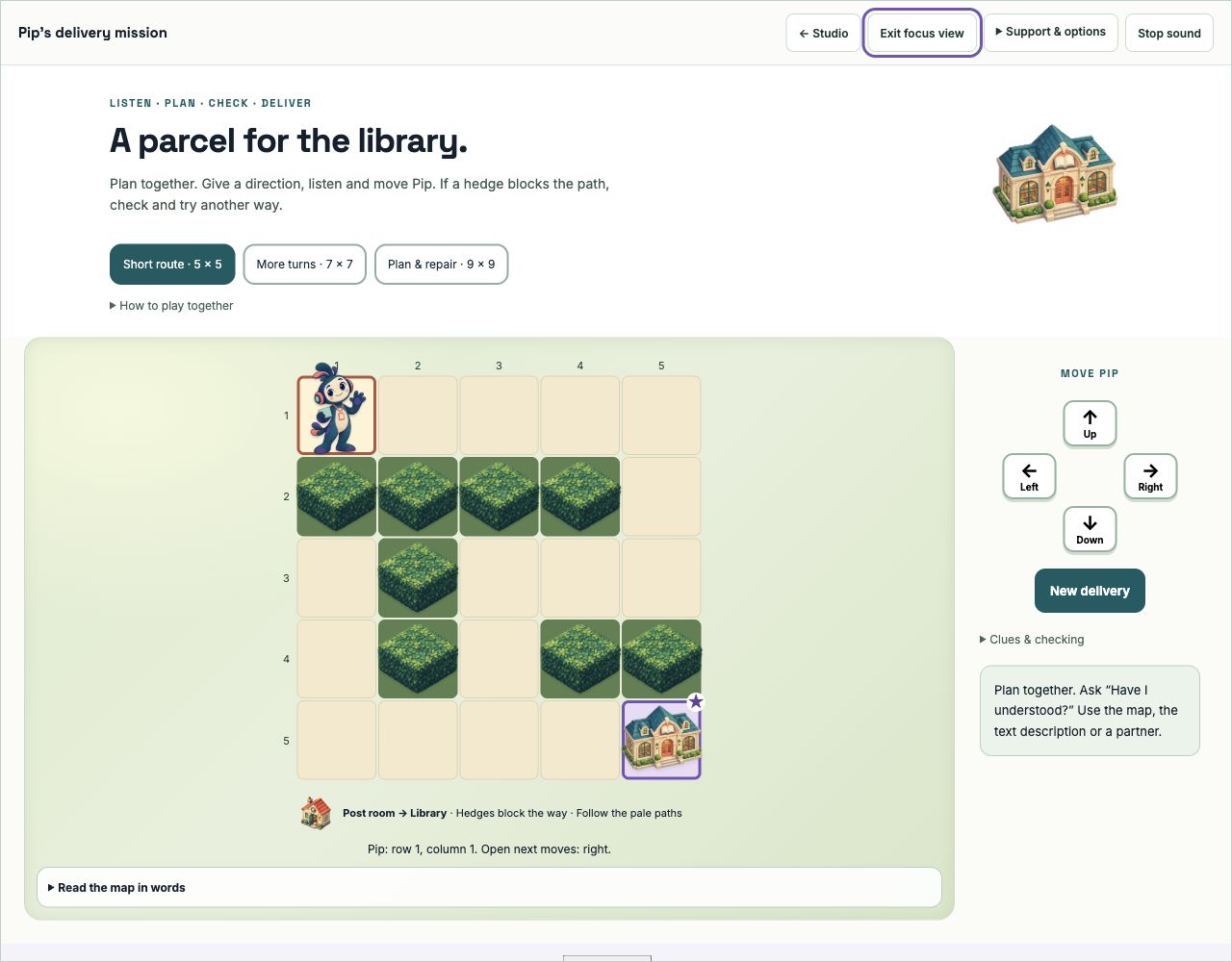
Matched physical blocks or the Studio hidden-model board, a screen between partners, repair phrase cards and AAC vocabulary for position, shape and clarification. Plan how to keep the target hidden and swap sender/receiver roles. Pip’s delivery now offers 5×5, 7×7 and 9×9 mazes with walls, a text map and next-step clue. Choose any challenge; it is not a pupil level.
Radio Check: choose a maze challenge, direct Pip around walls and use a checking question. A text map and next-step clue support access; swap roles before the hidden-model task.
Deliver the lesson 55 minutes · adapt the pace
5 MIN
Radio Check
Choose a route and rehearse a repair signal when pace is too fast. Model ‘Say that again’ and ‘I need time’. Let pupils choose device, symbol or partner routes.
In the system / room: Communication board plus Radio Check repair phrases.
8 MIN
Copy That
One person gives a two-part action, movement or object sequence; the partner copies. Repeat without a visual model. Ask what information was missing; keep sequence length manageable.
In the system / room: Room-based paired drama. A pupil can direct an adult's action.
8 MIN
Model a respectful repair
Adult gives a vague direction and another adult makes a plausible error. Model listen → ask/check → act. Make the misunderstanding a shared problem rather than a listener's failure.
In the system / room: Pip’s maze mission can model one direction and a checking question. Choose a challenge; a partner can operate the controls. Position, walls and open moves are available in text.
24 MIN
Can You Build It?
Sender views a hidden 3×3 target or physical model; receiver cannot see it. Sender describes one part. Hide the target before the receiver rebuilds. Pause to ask a checking question, then continue. Swap roles halfway through. An adult can operate the shared screen.
In the system / room: Open facilitator tools for hidden target and rebuild board. Use Show/Hide model, shape controls and cells. This is a shared-device task, not a two-device network link.
5 MIN
Compare and repair
Reveal both models and compare. Use feedback to find a position worth discussing. Identify a helpful detail or question, then repair together. Do not turn this into a speed contest.
In the system / room: Check models identifies differing positions; feedback is a discussion prompt, not an attainment score.
5 MIN
Playback
Pupils choose whether sending, receiving or checking felt easier. Name one repair phrase to use elsewhere. End with a familiar calm sign-off.
In the system / room: My Journey: record one real checking or repair moment, route and support.
Supported route
Use two shapes or objects, one position at a time, a familiar adult and prepared position vocabulary. Adult may voice the pupil's chosen instruction. For Pip’s delivery, use the short maze, one direction, the text map or next-step clue.
Independent route
Describe a small model, ask for clarification and swap roles.
Challenge route
Use a more complex model, unfamiliar partner or an ambiguous instruction that must be clarified. Keep AAC and thinking time. In the larger maze, plan two directions or recover from a dead end; keep the same access supports.
Drama facilitation
Coach reciprocal listening, purposeful waiting and responsibility for repair on both sides. Model errors without blame.
Teacher language
Have I got this right? Which detail would help your partner? A useful question can change the message.
Evidence worth keeping
Record a specific checking question, changed instruction or successful repair. Note opportunity, partner, communication route and support rather than only a matching model.
Continue
Repeat with a new target and swap roles.
Consolidate
Reduce model complexity and keep partner and vocabulary familiar.
Extend
Add a route map, more detail or a less familiar partner with agreement.
Between sessions
Use ‘Have I got this right?’ before acting during paired curriculum work.
Reflect and embed
Discuss whether you waited for a question or supplied the answer. Practise modelling an unclear instruction and a neutral repair.
DRAMA, PUPPETS & GROUPS
Copy That
Lead the game: At the warm-up, give a manageable action or object sequence. The partner copies, then checks missing detail. In Pip’s maze, separate the director and device operator.
Use a puppet here: A puppet can model an unclear instruction and a respectful repair before pairs try. Pupils may direct the puppet’s moves on a physical map.
Arrange the group: Pairs or trios within a supported group: sender/director, receiver/operator and optional checker. Swap roles by agreement.
RESOURCE BASKET
Puppets, props and communication
Puppets & props: Two matched sets of blocks/shapes; cardboard divider; simple position cards; a 3×3 physical grid if helpful.
AAC options: Radio Check board; position, shape, again, which one and checking vocabulary on usual AAC.
Prepare: Check physical or digital input access, keep the sender’s target hidden and plan the role swap.
Partners plan a pretend picnic. One instruction is unclear: ask, check and repair together.
Focus: Checking understanding and repairing messages
Optional 10-minute practice: welcome and choose (2), rehearse (5), notice and step out (3). Eating is optional; food-free, AAC, partner and listening routes are equal.
Transfer: Use a checking phrase during an ordinary shared table task.
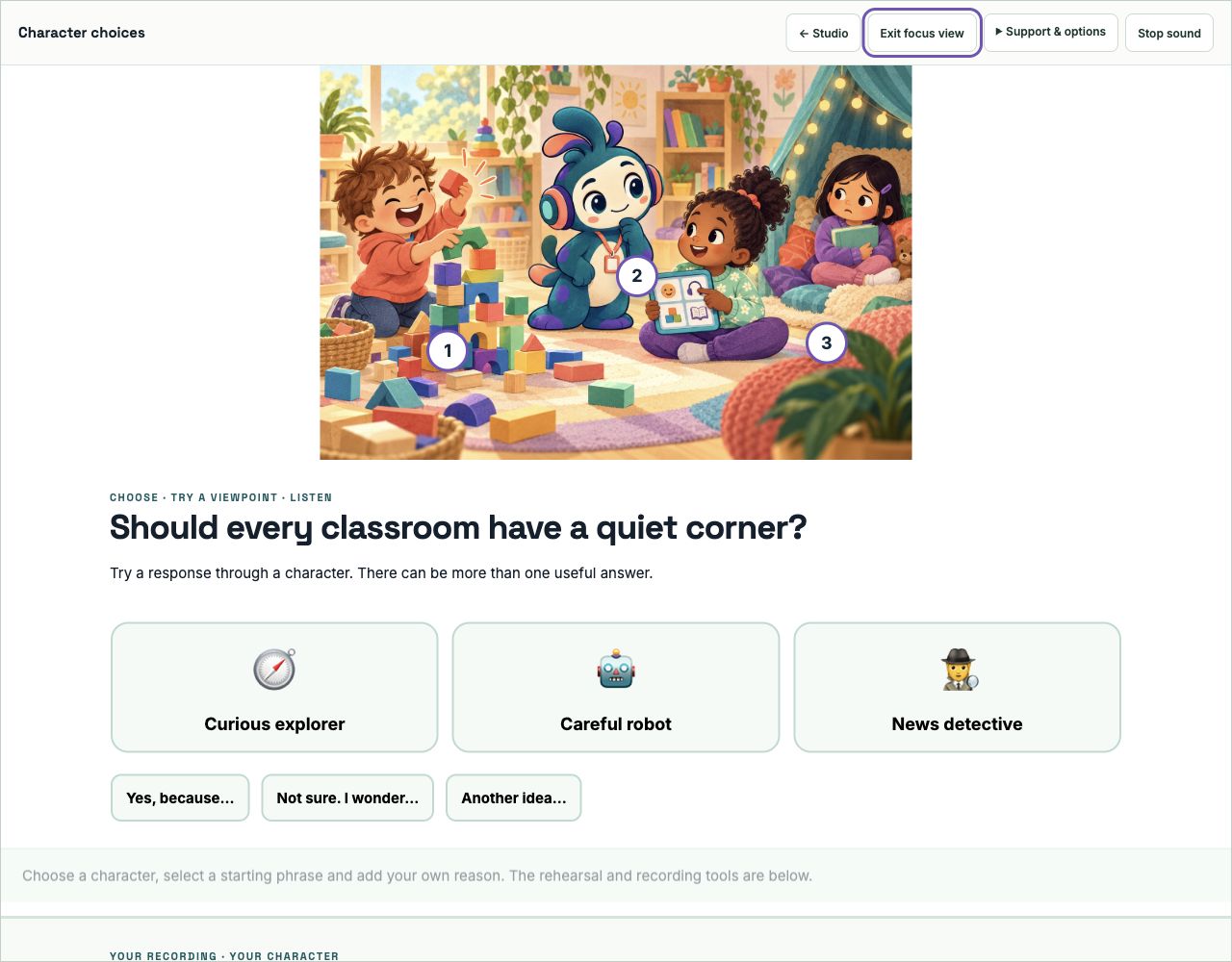
Character portraits or physical puppets, neutral dilemma about a quiet corner, AAC starters and headphones if wanted. Explain the fiction boundary. Test optional audio with an anonymous adult clip and agree recording permissions first.
Character Bridge: choose a fictional character and a manageable sharing route. A character can carry an idea; stepping out is always available.
Deliver the lesson 55 minutes · adapt the pace
5 MIN
Radio Check
Choose live, recorded, partnered, AAC, character-led or listening participation. Agree who may hear a rehearsal. Public sharing is not the default.
In the system / room: Character Bridge sharing choices in the rehearsal tools; communication board available.
8 MIN
Who Am I Today?
Adult chooses a fictional character and offers one movement, sound, symbol or phrase. Pupils choose a character or direct an adult. Practise a clear ‘back to myself’ action.
In the system / room: Character choices and portraits, or a real puppet; choice need not reveal anything personal.
8 MIN
Step into and out of role
Model how a character changes stance, rhythm or language. Make clear that the character may hold a view the pupil does not. Rehearse stepping out before trying the dilemma.
In the system / room: Use Step out of role to stop sound and clear in-role text. The adult still explains the fiction boundary.
22 MIN
A character viewpoint
Introduce ‘Should every classroom have a quiet corner?’ Choose yes, not sure or another idea and add a reason. Respond in role to a partner. The pupil can compose text, use AAC audio, ask a partner to voice it, or perform live.
In the system / room: Character Bridge: viewpoint starters, editable response and optional local speech; record/load audio only when permitted. The mouth overlay is a rehearsal effect, not video export.
7 MIN
Choose a comfortable rung
Offer choose → rehearse → record privately → one listener → optional group. Stop at a stretching but manageable point chosen with the pupil. Adding a live voice is optional.
In the system / room: Play/pause character audio; save the original audio before leaving if agreed. No upload or automatic sharing occurs.
5 MIN
Step out and reflect
Use the agreed exit action. Ask what the character made easier or harder and whether the audience choice felt right. Listen to a nonverbal or partner response without turning it into a score.
In the system / room: Step out of role, then My Journey: record agency, route and support.
Supported route
Choose character and response cards; adult voices the pupil-selected message. Keep a trusted partner and private rehearsal.
Independent route
Create a short in-role introduction and opinion; choose whether to record or share.
Challenge route
Sustain a two-way interview or answer one unplanned fictional question with permission and an exit route.
Drama facilitation
Teach role protection, status, hot seating and entry/exit from fiction. Coach calibrated challenge without exposing pupils or requiring disclosure.
Teacher language
The character can carry the message for now. Step out whenever you choose. What might this character notice or believe?
Evidence worth keeping
Record whether the pupil chose character, message and audience; describe the highest comfortable sharing step without treating a higher rung as automatically better.
Continue
Keep the character and explore a new safe topic.
Consolidate
Use prepared character speech and one familiar listener.
Extend
Try contrasting characters or a brief hot seat, retaining prepared questions and the right to step out.
Between sessions
Answer a curriculum question as an expert, reporter or fictional witness.
Reflect and embed
Discuss what role protection changed. Rehearse an invitation to step out and a response that accepts refusal without public persuasion.
DRAMA, PUPPETS & GROUPS
Who Am I Today?
Lead the game: At the warm-up, choose a fictional character and one movement, symbol or phrase. Rehearse stepping into role and a clear “back to myself” cue.
Use a puppet here: Use puppets in the main viewpoint task so fiction can carry an opinion. The pupil chooses the message and audience; the puppet’s view need not be their own.
Arrange the group: Small group modelling, then pairs/trios with a trusted listener. Keep public sharing optional and step out whenever wanted.
RESOURCE BASKET
Puppets, props and communication
Puppets & props: Two contrasting puppets or character pictures; neutral dilemma card; a visible step-out-of-role cue.
A puppet has been left out of the café conversation. Try an invitation, then step out of role.
Focus: Perspective and belonging
Optional 10-minute practice: welcome and choose (2), rehearse (5), notice and step out (3). Eating is optional; food-free, AAC, partner and listening routes are equal.
Transfer: Notice who has an accessible invitation and who needs more time.
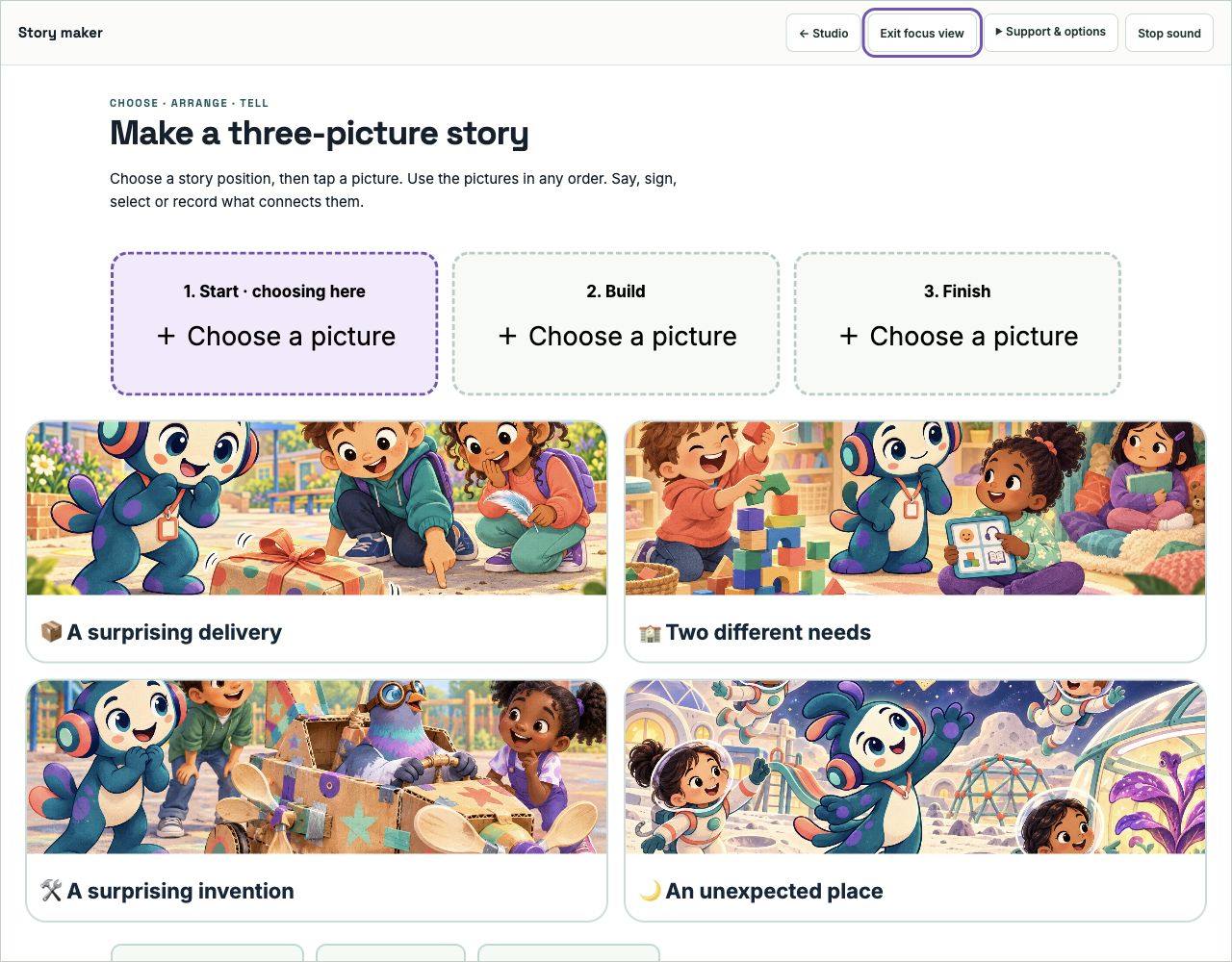
Three-picture sequences, objects or keywords; familiar topic choices; usual AAC and relevant vocabulary. Open Voice Lab for the message planner and Create for the optional picture storyboard. A 60-second target is a flexible frame, not a timed test. Prepare a predictable story stimulus: a familiar object, picture, sound or puppet. Preview it; surprise is optional.
Voice Lab: organise a fictional demonstration message into Start, Build and Finish. These optional boxes can support AAC preparation or partner scribing.
Deliver the lesson 55 minutes · adapt the pace
5 MIN
Radio Check
Choose ready / need ideas / choose for me and a route. Check the audience and whether preparation should be private.
In the system / room: Voice Lab methods/supports and communication board.
8 MIN
Yes… and…
Teacher offers a previewed object, picture, sound or puppet and opens a fictional story. Model “Yes… and…” to accept an imaginary detail and add one idea. Pupils build through speech, AAC, gesture, a sound, an object choice or directing a partner; allow thinking time, pass and alternative ideas. Shape the shared story into Start, Build and Finish. Accepting fiction never means agreeing to an unsafe action or unwanted participation.
In the system / room: Voice Lab: gather chosen details in Start / Build / Finish. Create’s three-picture storyboard is an optional visual scaffold.
8 MIN
Teach story shape
Model a muddled explanation, then rebuild it with three anchors: Start — my idea; Build — detail or reason; Finish — what to remember. Ask the listener what became clearer.
In the system / room: Voice Lab planning tools: Start / Build / Finish. Use one word, symbol or phrase per anchor if appropriate.
24 MIN
My World in 60 Seconds
Choose a familiar, safe interest or fictional idea. Plan three anchors, rehearse privately or with a partner, listen once and improve one thing that affects meaning. Pupils may communicate through AAC, symbol sequence, partner, text or live/recorded voice.
In the system / room: Voice Lab keeps draft text and offers local speech or voice-plan download. Recording, if wanted, uses the school's approved recorder or Character Bridge under agreed permissions.
5 MIN
One agreed question
Listener asks one prepared question. Presenter can answer now, prepare, pass or ask a partner to help. Model a thinking pause.
In the system / room: Communication board: I need time / Say that again / Help me.
5 MIN
Playback
Pupil chooses the strongest anchor and one useful change. Praise a specific sequencing or audience decision, not fluency or speed.
In the system / room: My Journey: record structure, route and support; download a plan only if useful.
Supported route
Sequence three images; adult scribes selected ideas. Use one idea per anchor and share privately or through a partner.
Independent route
Plan three anchors and communicate to a pair or small group with chosen support.
Challenge route
Use only three keywords/objects, adapt for a novice listener or answer one agreed unexpected question.
Drama facilitation
Guide imagination by accepting a fictional detail and adding one useful possibility. Model, wait, then follow the pupil’s idea. Keep contributions optional and preserve authorship.
Teacher language
What does your listener need first? Choose three anchors; you do not need a full script. A clear ending helps the audience.
Evidence worth keeping
Keep the planner if useful; record independence in sequencing, the scaffold used and how the pupil responded to a question. Notice whether adult help replaced the pupil's contribution.
Continue
Use the same structure for another familiar topic.
Consolidate
Reduce to one idea per section and rehearse privately.
Extend
Change audience, shorten preparation by agreement or add a counter-view.
Between sessions
Use three anchors before a science or history explanation.
Reflect and embed
Practise feedback that names message clarity. Discuss when a scribed word supports access and when it substitutes an adult's idea.
DRAMA, PUPPETS & GROUPS
Yes… and… story circle
Lead the game: Teacher offers a previewed object, picture, sound or puppet and opens a fictional story. Model “Yes… and…” to accept an imaginary detail and add one idea. Pupils build through speech, AAC, gesture, a sound, an object choice or directing a partner; allow thinking time, pass and alternative ideas. Shape the shared story into Start, Build and Finish. Accepting fiction never means agreeing to an unsafe action or unwanted participation.
Use a puppet here: A puppet introduces the stimulus or carries a pupil-selected story addition. Confirm the idea with the pupil; the adult supports access without inventing the pupil’s contribution.
Arrange the group: Pairs/trios with shared objects and one listener; a guided group can model the story first.
RESOURCE BASKET
Puppets, props and communication
Puppets & props: Three story cards or object photographs; Start / Build / Finish mat; a mystery basket with safe familiar props.
AAC options: Voice Lab and Create boards; familiar describing, sequencing and because vocabulary; partner scribing if chosen.
Prepare: Choose a shared fictional prompt; let pupils replace pictures with familiar symbols or objects.
An imaginary visitor arrives with a mysterious basket. Build a story together: start, build, finish.
Focus: Collaborative storytelling
Optional 10-minute practice: welcome and choose (2), rehearse (5), notice and step out (3). Eating is optional; food-free, AAC, partner and listening routes are equal.
Transfer: Share an optional fictional story starter; follow the pupil’s topic.
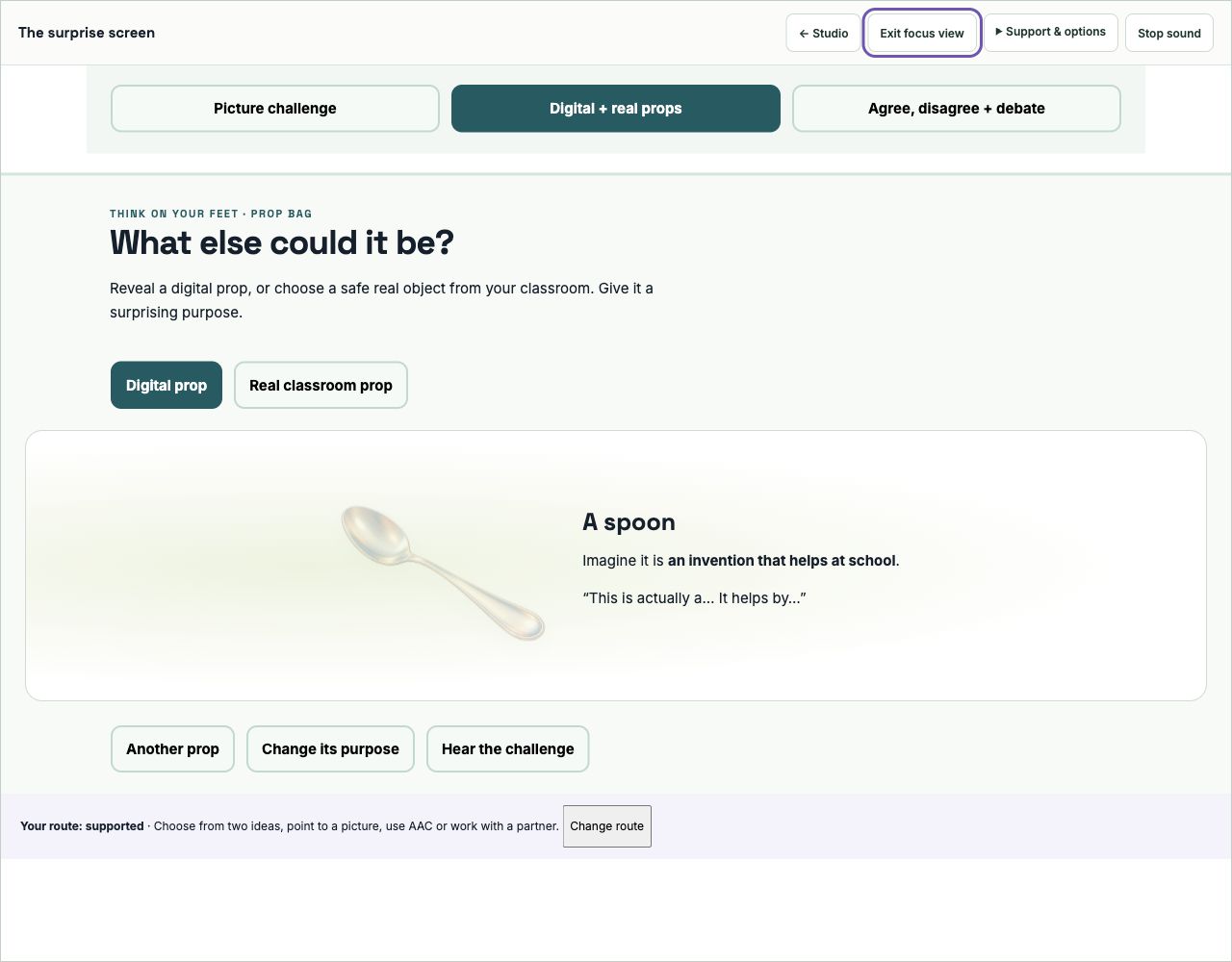
Funny picture, spoon/box/scarf/ball or digital props, recovery phrases and optional timer. Preview prompts for pupils who need predictability. Choose a manageable audience; unplanned prompts and timed challenges are optional.
On Air: choose a real or digital prop, invent a use and offer a reason. Pausing, previewing and recovering are valid parts of improvisation.
Deliver the lesson 55 minutes · adapt the pace
5 MIN
Radio Check
Choose challenge level, audience and one recovery phrase to keep visible. Agree a pass or pause signal.
In the system / room: On Air supports; communication board remains available in expanded activities.
8 MIN
Fortunately / Unfortunately
Build a fictional ensemble story one offer at a time. Model adding to a partner's idea. Invite a gesture, prepared phrase, AAC contribution or pass.
In the system / room: Room-based improvisation; adult scribes or voices a selected contribution if wanted.
8 MIN
Teach the recovery loop
Model pause → interpret → invent → communicate → continue. Make a deliberate mistake and restart calmly. Allow processing time; do not equate fast thinking with quality.
In the system / room: Help me recover offers a phrase; use Pause / listen first or Stop sound when needed.
10 MIN
Level 1: picture challenge
Reveal a picture, then invite one observation, possibility or character line. Ask what in the picture supported the idea. Rehearsing a previewed prompt is an equal route.
In the system / room: On Air: Picture challenge, next question, new picture and recovery controls.
10 MIN
Level 2: Sell It
Choose a real or digital prop. Imagine it has a new purpose for a chosen audience. Offer a short claim and one reason; a partner can perform the pupil's selected idea.
In the system / room: On Air: Digital + real props; select spoon, box, scarf, ball or own object. No shopping or real sales take place.
9 MIN
Level 3: a surprise contribution
Choose one route: surprise slide deck in facilitator tools, a short partner pitch, or agree/disagree with a reason. Preview or rehearse if needed. Listener asks one useful question before offering a counter-view.
In the system / room: On Air: surprise presentation or Agree/disagree + debate. Use reason/example/question before inviting a counter-view; native fullscreen is optional.
5 MIN
Playback
Name where the plan changed and what helped recovery. Accept requesting more time or passing as an access choice; ask whether the pupil wants to return.
In the system / room: My Journey: record a concrete recovery or listening moment and the support available.
Supported route
Preview prompts, choose response cards, work with a partner or record privately. Keep processing time unhurried.
Independent route
Choose a level and respond after around 20–30 seconds of preparation, adapting the interval to the pupil.
Challenge route
Try an unknown prompt, a live question or a chairing role with pupil agreement. Keep recovery phrases and exit choices.
Drama facilitation
Lead improvisation, productive failure and presence under pressure. Coach when to wait, prompt or reduce demand.
Teacher language
A pause looks thoughtful. Use the prompt; you do not need the perfect answer. Build on what your partner offered.
Evidence worth keeping
Record a recovery strategy, request for repetition or time, listening response and re-entry after a pause. Distinguish pace from communication quality.
Continue
Repeat the chosen level with a new prompt.
Consolidate
Preview prompts and practise recovery with a familiar partner.
Extend
Add a host role, live question panel or constrained format only when manageable.
Between sessions
Keep one recovery phrase visible during ordinary classroom presentations.
Reflect and embed
Practise making a mistake and restarting. Identify a moment where you could wait longer rather than rescue the pupil's contribution.
DRAMA, PUPPETS & GROUPS
Object Transformation
Lead the game: Choose a familiar safe prop and imagine another purpose. Model “This could be…” and a reason. Preview the prop where predictability helps.
Use a puppet here: Let a puppet introduce the prop, offer a deliberately playful idea or model “I need thinking time”. Pupils may direct the puppet instead of performing live.
Arrange the group: Small group with one prop at a time, then paired rehearsal. Offer two prepared ideas or a pass; no speed or surprise requirement.
RESOURCE BASKET
Puppets, props and communication
Puppets & props: Spoon, cardboard tube, hat or other familiar safe props; optional pretend microphone; question and recovery cards.
AAC options: On Air board; agree/disagree, reason, thinking-time and change-prompt vocabulary.
Prepare: Preview props where needed. Give an equal real-prop or picture route; no forced surprise or live performance.
Interview a fictional café guest. Respond to their idea before choosing a follow-up.
Focus: Reciprocal questions and responses
Optional 10-minute practice: welcome and choose (2), rehearse (5), notice and step out (3). Eating is optional; food-free, AAC, partner and listening routes are equal.
Transfer: Try a pupil-selected follow-up in a familiar conversation.
Offer Podcast, Newsroom, Radio drama, Character show, Presentation show or Mini documentary. Prepare role choices, AAC scripts and a three-beat structure. Agree audience, permissions, approved tools, storage and deletion before recording.
Create: choose and arrange three story pictures. Give every production role a communication goal; this demonstration sequence is not pupil evidence.
Deliver the lesson 55 minutes · adapt the pace
5 MIN
Radio Check
Choose energy, role preference and one support. Remind the group that speaking on camera or into a microphone is optional.
In the system / room: Communication board; Create role choices in planning tools.
8 MIN
Project pitch
Choose one route, one audience and one purpose. Keep the scope small enough to finish a rough draft. Model a brief idea, then wait for pupil choices.
In the system / room: Create: six worked examples can seed a plan; teachers explain that examples are fictional briefs, not saved pupil projects.
8 MIN
Roles and goals
Allocate meaningful roles such as question writer, AAC contributor, actor, director, sound operator or accessibility lead. Each pupil chooses a communication goal: ask, check, cue, explain, listen or contribute a prepared message.
In the system / room: Create production planner: choose format, roles and role goal. Use shared planning without names in this demo.
24 MIN
Production sprint
Plan Start / Build / Finish, rehearse, then make a short rough performance or recording. Listen/view once and choose one change that improves meaning or access. A live room-based performance is a complete route.
In the system / room: Create is a working storyboard and production planner, not an audio/video editor. Use the school's approved editor or recorder for final media; no external account is required by the Studio.
5 MIN
Team review
Ask ‘What is clear?’ and ‘What is the next useful change?’ Check whose contribution is missing. Include technical and offstage roles in the conversation.
In the system / room: Production checklist and downloadable plan; add captions/transcript or visual sequence in the chosen approved tool.
5 MIN
Playback
Each pupil identifies their own contribution and the communication choice that helped. Save only a useful artefact with permission.
In the system / room: My Journey: one concise observed moment per pupil in the school's approved records; anonymous demo snapshot if appropriate.
Supported route
Prepared contribution, paired role, symbol/AAC script, private recording or a technical role with a communication goal.
Independent route
Complete a defined role and contribute to a planning or review decision.
Challenge route
Lead transitions, interview, edit for an audience or solve a production problem while retaining access supports.
Drama facilitation
Direct groups without taking over; allocate equitable roles and coach authentic ensemble delivery rather than imitation.
Teacher language
Every role communicates; name how yours does. Make the message clear before making it polished. Whose voice is missing?
Evidence worth keeping
Collect one useful artefact plus one short observation of a pupil's contribution. Notice collaboration, decisions and repair as well as the final output.
Continue
Keep roles and goals and continue production.
Consolidate
Narrow the scope and finish one strong section.
Extend
Add a specific audience need, host role or peer production responsibility. External sharing requires separate school approval.
Between sessions
Use role-specific communication goals in another collaborative curriculum task.
Reflect and embed
Discuss how roles were allocated and whether a quieter or AAC contribution changed a group decision. Choose one directing move to hand back to school staff.
DRAMA, PUPPETS & GROUPS
Ensemble radio scene
Lead the game: Build a short scene with Start, Build and Finish. Assign purposeful roles: idea, cue, sound, character or listener/checker. Rehearse once before any recording.
Use a puppet here: Use a puppet as narrator or character in the production. The pupil can voice, select a recorded/AAC line, direct the action or give a cue.
Arrange the group: A production group of 4–6, using pairs for rehearsal. Give each role a communication purpose; no pupil must perform publicly.
Plan a café, picnic or food-free welcome gathering. Negotiate roles and one shared decision.
Focus: Collaboration and agency
Optional 10-minute practice: welcome and choose (2), rehearse (5), notice and step out (3). Eating is optional; food-free, AAC, partner and listening routes are equal.
Transfer: Let pupils choose an authentic hosting or planning role.
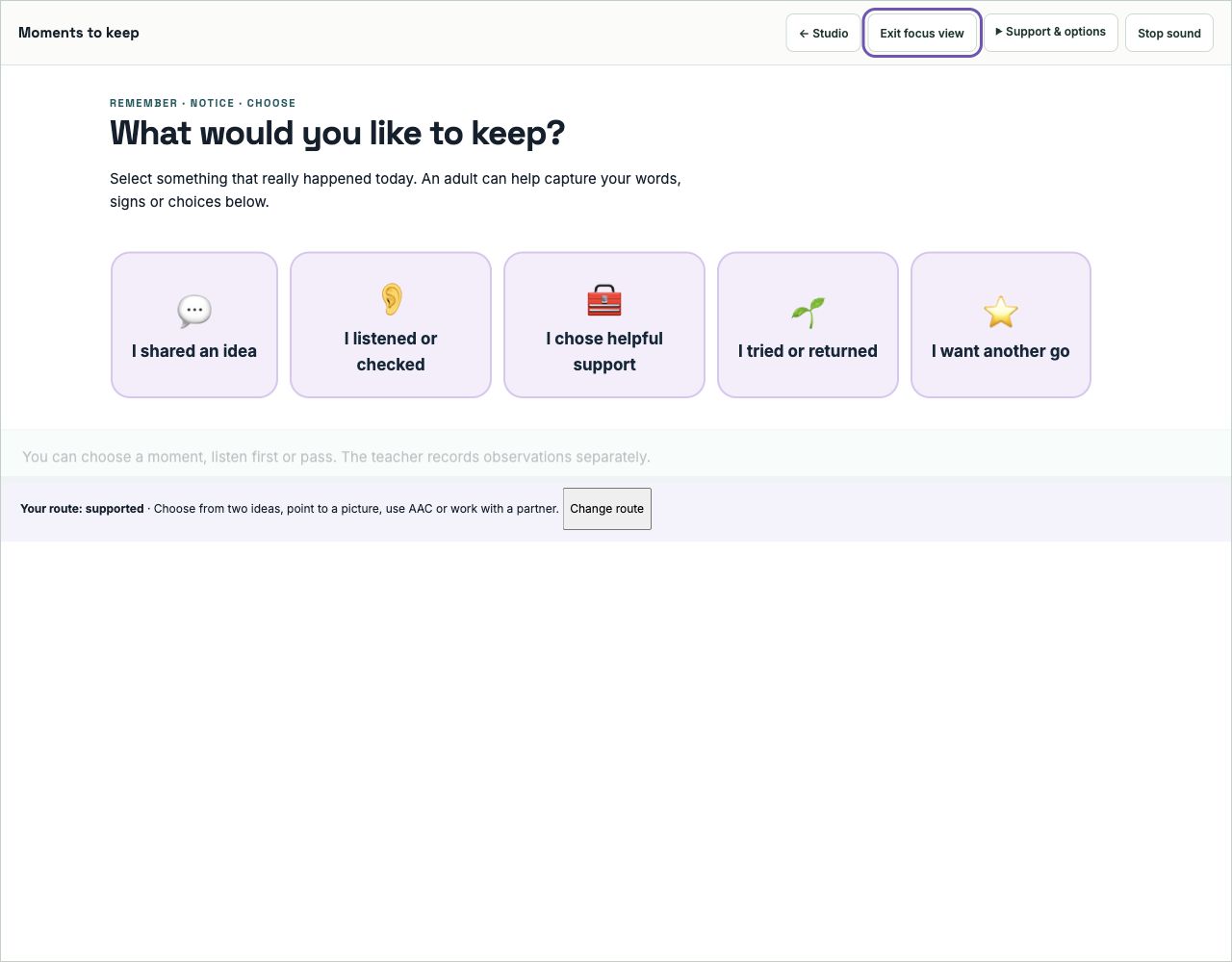
Original Week 1 task wording and route/support notes, pupil-selected evidence from Weeks 1/3/4/6/7, private/public sharing choices and a calm audience protocol. Keep identifiable evidence in school-approved storage.
My Journey: choose a reflection only when it describes a real experience. This screenshot shows an example selection, not a recorded pupil outcome.
Deliver the lesson 55 minutes · adapt the pace
5 MIN
Radio Check
Choose visibility for today: private, one listener, partner share, small group or no public share. Identify one support. A pass does not erase progress.
In the system / room: Communication board; adult confirms audience choice before opening recordings or notes.
8 MIN
Return to a starting task
Repeat one Week 1 task with the same wording and comparable support. Ask what feels different. A changed environment, opportunity or communication system should be noted, not ignored.
In the system / room: Return to Voice Lab or Drama Lab as appropriate; My Journey stores the starting-task description and route.
12 MIN
My Journey
Pupil selects real moments: ‘I used to… / Now I can… / Next I would like to…’. Use exact words, signs or selections where possible. Teacher compares each strand separately and records uncertainty or not-yet-observed.
In the system / room: My Journey: moments, baseline/current descriptors, strength, barrier, next goal and readable export. No combined score is generated.
20 MIN
Chosen showcase
Share a pupil-selected piece or contribution with an agreed audience. Options include live drama, audio, transcript, device output, partner presentation, private reflection or no public showing. Audience notices meaning, listening, recovery or ensemble contribution.
In the system / room: Reopen the chosen Studio activity or approved saved media. This app does not publish or broadcast a showcase.
5 MIN
Evidence-based recognition
Name a specific change with evidence and the support that helped. Avoid rankings, superlatives or praise that increases unwanted exposure.
In the system / room: Record an actual communication moment, not a fabricated completion badge or score.
5 MIN
Agree the next step
Choose a next goal, everyday context, support adult/role and review date. Confirm who will revisit it. End with the familiar sign-off and clear shared-device notes after any agreed export.
In the system / room: My Journey next-step fields, Continue / Consolidate / Extend, snapshot and readable journey download. Clear session does not delete downloaded files.
Supported route
Private review with a trusted adult, adult presents pupil-selected evidence, or no public share.
Independent route
Share selected evidence with an agreed audience and use reflection prompts through a chosen route.
Challenge route
Host, introduce others, answer a question or explain access choices with agreement and a clear exit route.
Drama facilitation
Coach evidence-based confidence feedback and a showcase that celebrates manageable risk, recovery and ensemble contribution.
Teacher language
You choose what is shared and how. What can you do with more choice, less support or a different audience? Your next step should matter beyond today.
Evidence worth keeping
Repeat a comparable Week 1 task and pupil rating. Compare five strands separately, retain pupil voice, and agree one goal, context, support role and review date. Not yet observed is not zero.
Continue
Carry the next goal into classroom routines and revisit at the agreed date.
Consolidate
Repeat a successful route with stable support and a smaller audience.
Extend
Offer a supported host, ambassador or mentor opportunity with pupil agreement and school safeguards.
Between sessions
Revisit the goal in ordinary learning and ask whether the support increased agency.
Reflect and embed
Review pupil evidence and teacher facilitation changes separately. Identify what staff can now lead, which access barriers remain and what an arts/technology partner could help develop next.
DRAMA, PUPPETS & GROUPS
Replay and notice
Lead the game: Repeat a familiar starting task or brief scene with comparable access and support. Invite the pupil to choose a moment, say what helped or pass.
Use a puppet here: The pupil may choose a puppet to carry their selected reflection or next goal. Confirm the message; do not use the puppet to pressure disclosure.
Arrange the group: A familiar small group or trusted partner. Agree an audience and keep feedback private when preferred.
RESOURCE BASKET
Puppets, props and communication
Puppets & props: A selected anonymous example or object from earlier work; starting-task resources; simple feedback choices; next-step card.
AAC options: My Journey and Everyday choices boards; a pupil-selected reflection route; usual AAC vocabulary for the next goal.
Prepare: Repeat a comparable task, give a pass option and choose one target together. Use the impact desk’s quick review.
Host a small pretend celebration. Repeat the welcome task and notice what helps everyone join.
Focus: Transfer and reflection
Optional 10-minute practice: welcome and choose (2), rehearse (5), notice and step out (3). Eating is optional; food-free, AAC, partner and listening routes are equal.
Transfer: Agree one routine to continue and review it in 4–6 weeks.
Keep five strands separate: confidence and participation; expressing ideas; listening and responding; presentation and performance; communication choices. Record Not yet observed, With substantial support, With a prompt or familiar scaffold, or Independently / transfers. Not yet observed is not zero. These are descriptive observations, not a validated scale. Compare context, opportunity, regulation, route and support; never total the strands or rank pupils.
Minimum evidence: Week 1 starting task, route, strength, barrier and pupil rating; Weeks 2–7 one useful moment per pupil; Week 8 comparable starting task, selected evidence, pupil reflection and a next goal, context, support role and review date.
Use school-approved records for identifiable evidence. A Studio snapshot contains plans and observations, not audio or live picture-game state. One tab is not a multi-pupil record system.
Develop adult practice
Use the staff workshop, weekly practice and huddles, then observe facilitation independently. Review pupil experience alongside adult practice.
Interactive prompts, planning, storyboarding, observations, exports and local snapshot import work in this demonstration. Recording, local voices, playback effects and native fullscreen depend on the school device and browser. Create is a planner, not a media editor; there is no live broadcast, multi-user school database or video export.
Before pupil use, test keyboard/switch access, screen reader, zoom, touch, AAC formats, microphone permission grant/denial and local voice availability with adults. Confirm that each pupil can pause, pass, select support and return. Automated checks do not certify accessibility or suitability.